Structural analysis - PyMAPDL / MAPDL
SUPPORTEDParametric Offshore Jacket Structural Analysis
Overview
Objective and scope
The newly reviewed package contains the accepted source document, parametric geometry, design-basis records, PyMAPDL/MAPDL implementation, retained solver outputs, validation matrices, deterministic tests, and project figures. The public case presents the accepted baseline and screening results while keeping the failed M12 stability gate visible.
Engineering question
A preliminary jacket model is only useful when its source basis, assumptions, model topology, solver states, and validation boundaries remain traceable from input to result.
Objectives
- Preserve the source-to-model trace for the JKT-A BOL preliminary jacket baseline.
- Publish bounded M10 combined-static and M11 gross-section screening evidence with the declared assumptions.
- Keep the M12 mesh-convergence and equilibrium failures visible instead of presenting an unfinished stability screen as a pass.
Method
How the work was approached
- Audit the accepted source document, project configuration, geometry/topology records, sections, loads, and run manifests.
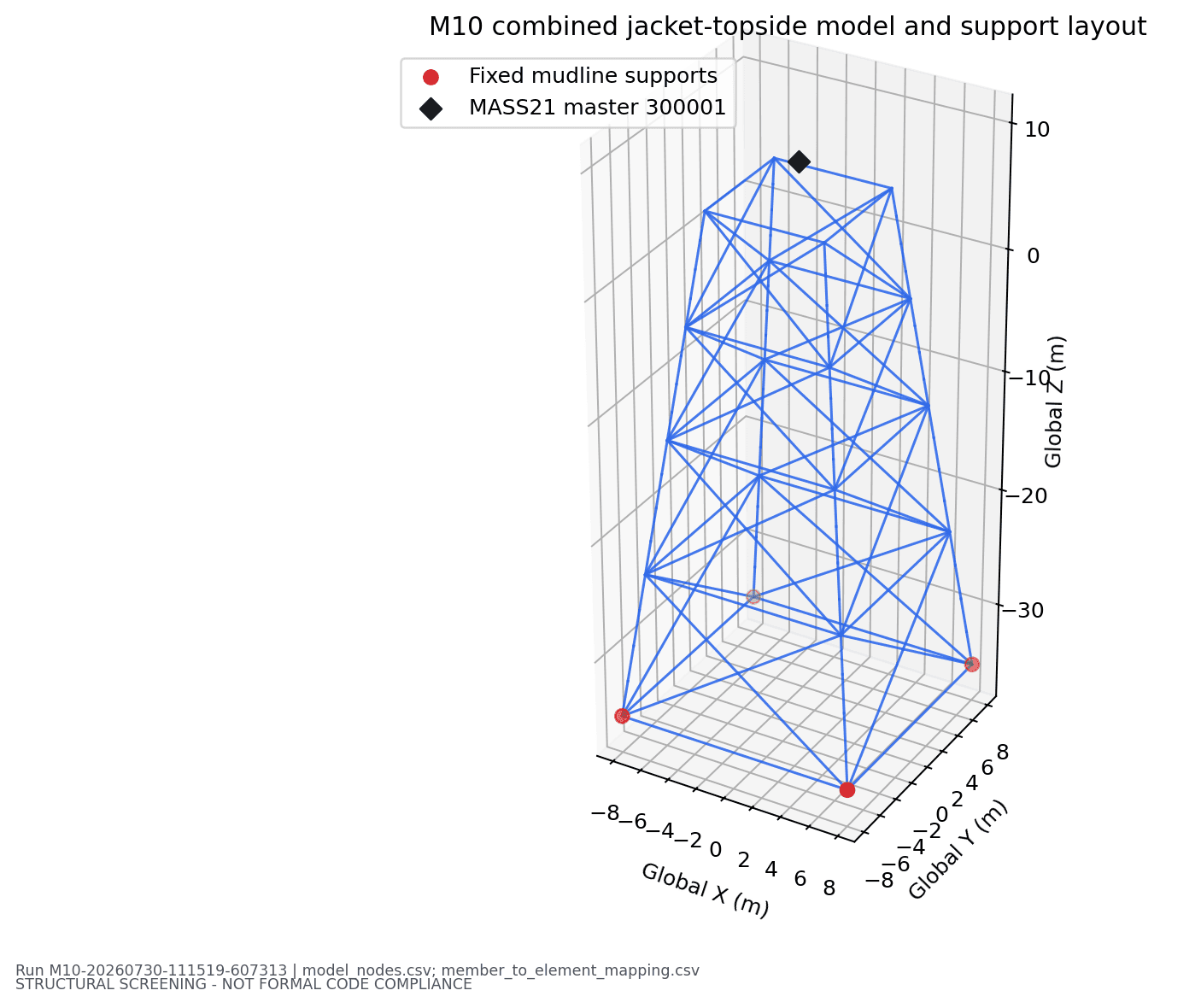
- Build and verify the BEAM188 fixed-base model, then evaluate the 361-state M10 combined linear-static screening set.
- Recompute M11 gross-section screening independently and retain M12 elastic-stability results as a failed/open gate.
Tools
Assumptions and boundaries
- JKT-A is an academic preliminary BOL model with fixed mudline supports, rigid centerline joints, and connected rigid X-crossings.
- The baseline uses gross starting sections, linear elastic steel, flooded legs, and a preliminary equivalent topside mass representation.
- Environmental and topside inputs remain selected academic assumptions, not approved site or production design inputs.
- All results remain structural screening and are not formal code compliance or a construction/design deliverable.
Traceable jacket analysis workflow
From evidence to review
- 01Source audit
- 02Parametric geometry
- 03BEAM188 model
- 04M10 static screen
- 05M11 response screen
- 06M12 stability gate
Evidence
What the public case is based on
- Accepted source document and hash recorded in CURRENT_STATUS.md: B956A298717EB0C976BE90821054DCF34E64FFB2E358DE2C1B7348F45AFF4954.
- Parametric geometry, design-basis, materials/sections, load mapping, and PyMAPDL implementation records for JKT-A BOL.
- M10 combined-static report and retained run package; M11 structural-response screening report and independent test record.
- M12 elastic-stability report and M12-R1 controlled-stop report documenting the failed gate and license blocker.
Validation
- M04 independent checks passed 240/240 comparisons; the accepted geometry contains 36 design joints, 100 engineering members, and 16 connected X-crossing joints.
- M10 completed 361/361 intended combined linear-static states with force recovery, equilibrium, fresh readback, diagnostics, and 20/20 visual checks passing.
- M11 independently recomputed section properties and stresses, passed its declared gates, and recorded 507/507 automated tests plus 15/15 visual checks.
- M12 completed its declared solver program and visual checks, but failed mesh convergence and nonlinear moment-equilibrium gates; M12-R1 stopped before any new solve because the ANSYS Student license had expired.
Results
Selected, bounded observations
- 36 / 100
- design joints / engineering membersaccepted parametric JKT-A topology
- 361 / 361
- M10 static statesintended / completed combined screening states
- 0.0911
- M11 gross first-yield ratiomaximum Rmax; not code utilization
- 3.991%
- M12 mesh deltaMESH-4 to MESH-8; exceeds the 2% gate
| Evidence class | Observed result | Interpretation boundary |
|---|---|---|
| Geometry and model | 36 joints; 100 engineering members; 184 nodes; 148 BEAM188 elements | Fixed-base academic baseline with rigid centerline joints. |
| M10 combined static | 361/361 states; maximum total displacement 0.006188831106 m | Linear structural screening, not formal code compliance. |
| M11 response screen | Gross-section Rmax 0.0911230359295 | Elastic first-yield screen; no formal member utilization. |
| M12 stability | MESH-4 to MESH-8 lambda1 change 3.991125849%; accepted mesh NONE | M12 FAIL; M13 not permitted or started. |
Reported results
- The accepted baseline is 36 design joints, 100 engineering members, 184 MAPDL nodes, and 148 BEAM188 elements before the combined topside representation.
- M10's governing combined-static case reached a maximum total displacement of 0.006188831106 m in the documented screening model.
- M11's gross-section elastic first-yield screen recorded Rmax 0.0911230359295 at LEG_NE_BAY_4; this is not a formal code utilization check.
- M12's finest evaluated eigenvalue multiplier was 95.260397, but no mesh was accepted because the MESH-4 to MESH-8 change was 3.991125849% against the 2% gate.
Key takeaways
- The package now supports a real, auditable preliminary jacket case rather than only a CV-indexed project title.
- Static response and gross-section screening are bounded by passing gates, while stability remains an explicitly unresolved engineering review item.
- The evidence supports a portfolio case study, not an optimized, certified, code-compliant, or construction-ready design claim.
JKT-A BOL preliminary design and structural screening; M12 stability gate remains open. The specific limitations below remain part of the case, not footnotes.
Limitations
- Student engineering study for learning and portfolio purposes; it is not a certified design deliverable.
- Fixed-base modelling omits pile-soil flexibility and foundation capacity; beam centerlines omit local shell, joint, fabrication, and hotspot effects.
- Formal API RP 2A-WSD checks, fatigue, nonlinear collapse, installation, seismic, accidental, EOL corrosion capacity, and SACS comparison are outside the retained scope.
- M12 has no accepted mesh and remains FAIL; M13 corrosion/EOL work is not permitted or started, and a new stability correction requires a valid ANSYS license.
What I learned
- Keep source inputs, derived properties, selected assumptions, solver results, and unresolved gates in one traceable chain.
- A failed convergence gate is part of the engineering result and should remain visible in the public case study.